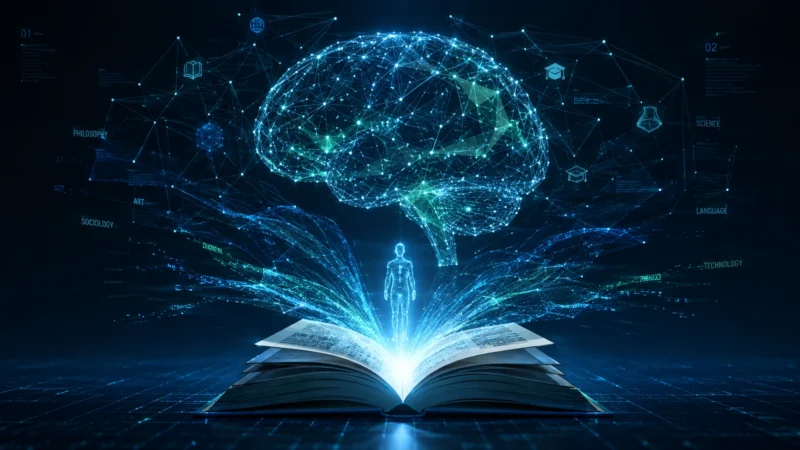


Executive Summary
The global education system faces an intractable “impossible triangle” of personalization, quality, and universal accessibility. UNESCO projects a global teacher shortage of 44 million by 2030, while current educational AI — whether adaptive quiz platforms or conversational large language models — remains trapped at the surface level of content distribution, incapable of modeling the inner cognitive states of learners.
A landmark white paper jointly published in July 2026 by the AIII International AI Research Institute and Tianli Qiming AI Research Institute proposes a radical reimagining: constructing a Cognitive World Model (CWM) that can internally simulate a learner’s knowledge evolution, predict misconception resolution trajectories, and autonomously generate optimal instructional interventions. This represents nothing less than a foundational paradigm shift from “information delivery” to “cognitive simulation” — the pathway toward true Educational AGI.
This article provides an independent, comprehensive interpretation of the white paper’s key frameworks, data, and strategic implications for the global education technology landscape.
Table of Contents
- The Structural Crisis of Education Digitalization
- From Physical World Models to Cognitive World Models
- The Educational AGI Vision: Defining a New Frontier
- Global Competitive Landscape: Three Divergent Paths
- The Emergent Education Paradigm
- Architecture: The “4+1” Framework and Three Core Engines
- The LAM Loop: Unifying Four Technical Lineages
- Seven Core Technical Challenges
- Four Value Scenarios Reimagined
- Token Economy and Business Pathways
- Ethical Governance and Cognitive Sovereignty
- The Road Ahead: Policy, Industry, and Academic Action Agenda
1. The Structural Crisis of Education Digitalization
1.1 The Three-Phase Evolution of Education Technology
| Phase | Era | Core Capability | Key Limitation |
|---|---|---|---|
| Phase I: Informatization | ~1990s–2000s | Computers and internet built information highways; knowledge recorded, stored, transmitted | Data largely static; limited value extraction |
| Phase II: Digitalization | ~2000s–2020s | Sensors, LMS, online classrooms created “digital twins” of learning behaviors; data-driven process optimization | Analysis reliant on preset rules and statistical models; AI stuck at “electronic tutoring” and “content recommendation” |
| Phase III: Cognitive Intelligence | 2020s→ | Moving into the cognitive layer; traditional paths hitting structural ceiling | Requires fundamentally new technical substrate |
The white paper argues that the past two decades of education digitization essentially completed an “information migration” — we moved blackboards onto screens, paper homework into databases, and classroom lectures into video streams. We built magnificent information highways but rarely asked: How does learning actually happen in the individual mind?
1.2 Three Structural Dead Ends
The white paper identifies three interconnected crises that have brought traditional education technology to its limits:
| Crisis | Core Problem | Manifestation |
|---|---|---|
| Quality Crisis | Uniform pace vs. heterogeneous cognition | Classroom instruction assumes cognitive homogeneity; most students languish in either “comfort zones” (under-challenged) or “panic zones” (overwhelmed); only a minority hit the optimal “learning zone” |
| Cost Crisis | Deep personalization’s prohibitive marginal cost | True one-on-one instruction requires continuous diagnosis, dynamic path adjustment, and precise intervention — economically viable only through small class sizes or tutoring, which cannot scale |
| Technology Crisis | Cognitive black boxes and tool-mode traps | Current AI (adaptive quizzes, LLM chatbots) operates on statistical correlations and pattern matching, not genuine cognitive modeling; can record “what a student did” but cannot answer “why they think that way” |
These three crises converge on a single insight: if education digitization cannot descend from the “information layer” to the “cognitive layer,” the marginal utility of existing tools has hit a ceiling. This is the historical imperative driving World Model technology into the education domain.
2. From Physical World Models to Cognitive World Models
2.1 The Three Technical Lineages of World Models
The white paper traces the evolution of World Models from Ha & Schmidhuber’s 2018 framework through Yann LeCun’s JEPA architecture to the present day, identifying three major technical schools with distinct educational applications:
| World Model School | Representative Systems | Core Mechanism | Educational Mapping |
|---|---|---|---|
| Generative Pixel Prediction | OpenAI Sora, NVIDIA Cosmos | Large-scale unsupervised fitting of spatiotemporal data; emergent spatial intelligence and physical intuition | High-fidelity virtual experiments, historical scene reconstruction, dynamic geometry visualization — transforming abstract knowledge into observable, interactive situational experiences |
| Latent Space State Prediction | Meta JEPA Series (V-JEPA 2) | Self-supervised prediction in abstract latent space; avoids pixel-level reconstruction overhead; 15x faster planning vs. video generation models; strong zero-shot cross-scene transfer | Cognitive dynamics simulation of learners’ knowledge graphs, misconceptions, cognitive load, and motivational states — all “latent states” that match JEPA’s methodological philosophy |
| Reinforcement Learning & Planning | DeepMind MuZero, Dreamer | Implicit state-space modeling combined with Monte Carlo Tree Search (MCTS) for multi-step optimal sequential decision-making | Global teaching strategy planning: system uses current cognitive “latent state” as starting point, internally simulates long-term cognitive gains from different instructional sequences, solves optimal personalized tutoring paths |
2.2 The Cognitive World Model (CWM) Formal Definition
The white paper adapts the Partially Observable Markov Decision Process (POMDP) — the mathematical backbone of autonomous driving and robotics — into a Cognitive World Model defined as a 7-tuple:
CWM = <S, A, Z, T, O, R, b₀>
| Component | Physical World Model (Autonomous Driving) | Cognitive World Model (Educational AGI) |
|---|---|---|
| S (State Space) | Object position, velocity, acceleration, environment geometry | Knowledge mastery, misconception distribution, cognitive load, motivational-emotional states |
| A (Action Space) | Steering torque, throttle, robotic arm rotation/displacement | Question selection, explanation/hint/follow-up, pacing control, collaboration organization |
| Z (Observation Space) | Camera pixels, LiDAR point clouds | Answer correctness, response time, eye-tracking trajectories, clickstreams, voice content |
| T (Transition Dynamics) | Newton’s laws, rigid body kinematics | Knowledge acquisition, forgetting curves, cross-domain transfer, conceptual change patterns |
| O (Observation Model) | Sensor imaging equations, photoelectric conversion | IRT, DINA, and other Cognitive Diagnostic Models (CDM) |
| R (Reward Function) | Task completion, collision-free path, shortest route | Delayed retention rate, knowledge transfer capability, cognitive autonomy growth |
| b₀ (Cold-Start Prior) | High-precision scene maps, SLAM initial mapping | Hierarchical Bayesian initial belief distribution across learner populations |
This cross-domain structural isomorphism means that cutting-edge AI algorithms in state estimation, MCTS, and long-range planning possess transferable potential to education — provided the industry anchors them with education science, reconstructing the transition matrix (T) and reward mechanism ® to align with human cognitive development.
3. The Educational AGI Vision: Defining a New Frontier
3.1 Differentiating Educational AGI from Existing Technologies
The white paper carefully positions Educational AGI not as a linear extension of LLMs, but as a generational leap requiring three capability bridges:
- From content generation to mechanism understanding: Not just “generating teaching content,” but “understanding how learning occurs”
- From passive response to proactive intervention: Not just “responding to questions,” but “predicting cognitive bottlenecks and intervening proactively”
- From local recommendation to global planning: Not just “recommending the next question,” but “planning medium-to-long-term optimal conceptual construction sequences”
| Dimension | Traditional Ed Software | Educational LLM | Educational Agent | Educational AGI (Vision) |
|---|---|---|---|---|
| Core Capability | Content presentation & static storage | Text generation & semantic dialogue | Task execution & tool calling | Cognitive simulation, counterfactual reasoning, autonomous planning |
| Interaction Depth | One-way information delivery | Single/multi-turn Q&A | Rule-based workflow interaction | Closed-loop cognitive intervention, cross-session long-term memory |
| Personalization | None or shallow classification | Coarse-grained user labels | Rule-engine conditional branching | Latent-space dynamic modeling, true hyper-personalization |
| Cognitive Process Understanding | Absent | Statistical semantic correlation only | External preset rules & workflows | Endogenous cognitive dynamics model |
| Technical Foundation | Relational DB + UI | Large Language Model (LLM) | LLM + external tool APIs | World Model + Multi-Agent Collaborative Architecture |
3.2 Agentic Educational Infrastructure (AEI)
The white paper introduces a crucial intermediate concept: Agentic Educational Infrastructure (AEI). If ideal Educational AGI is the “brain” with deep cognitive empathy, AEI is the “nervous system”遍布教学场景. AEI has three defining characteristics:
- Cognitive-Native: Supports continuous modeling and efficient computation of learner cognitive states from the ground up in data and computing architecture
- Autonomous Instruction: Teaching decisions no longer depend on manually preset rules, but emerge from autonomous strategy generation and dynamic optimization based on environmental feedback
- Collective Intelligence: Breaks the “standalone” model, constructing a micro-ecosystem where teachers, students, and multiple AI Agents symbiotically collaborate and co-evolve
Keywords: Educational AGI, Cognitive World Model, World Models in Education, LAM Framework, Emergent Education, Learner Digital Twin, AI Education Paradigm, Cognitive Sovereignty, Edu-Token ROI, Agentic Educational Infrastructure, AI in Education 2026






No comments yet